


A bloc of Democratic senators has opened an investigation into a major policy shift at the Environmental Protection Agency that would change how the agency evaluates the benefits of air pollution controls. The lawmakers argue that the move could allow the EPA to sideline the health impacts of pollution when crafting new rules, reshaping the balance between public health protections and industry compliance costs.
The inquiry centers on a decision by the Trump administration’s EPA to stop assigning a monetary value to the health benefits associated with regulations on fine particulate matter, known as PM2.5, and ozone. The policy was first reported last month, when it was revealed that the agency planned to stop tallying the financial value of health benefits tied to curbing those pollutants and instead focus exclusively on the costs regulations pose to industry.
In a regulatory impact analysis, the EPA said it would stop monetizing the health benefits connected to limits on PM2.5 and ozone, arguing that the estimates contain too much uncertainty. An internal email dated December 11 and written by an EPA supervisor to staff outlined the rationale. “Historically, the EPA’s analytical practices often provided the public with false precision and confidence regarding the monetized impacts of fine particulate matter (PM2.5) and ozone,” the supervisor wrote. “To rectify this error, the EPA is no longer monetizing benefits from PM2.5 and ozone.”
More than three dozen Democratic senators have now begun what they describe as an independent inquiry into that shift. The effort is being led by Sen. Sheldon Whitehouse, the ranking member of the Senate committee on the environment and public works. In a letter sent Thursday to EPA Administrator Lee Zeldin, the senators sharply challenged the new policy.
“EPA’s new policy is irrational. Even where health benefits are ‘uncertain,’ what is certain is that they are not zero,” the lawmakers wrote. They warned that the change “will lead to perverse outcomes in which EPA will reject actions that would impose relatively minor costs on polluting industries while resulting in massive benefits to public health including in saved lives.”

The senators argued that the revised approach conflicts with federal law. “It is contrary to Congress’s intent and directive as spelled out in the Clean Air Act. It is legally flawed,” they wrote. “The only beneficiaries will be polluting industries, many of which are among President [Donald] Trump’s largest donors.”
Under prior practice, the EPA included in its cost benefit analyses a dollar figure reflecting the health gains of cleaner air. Those estimates incorporated fewer premature deaths, reduced illness, and outcomes such as avoided asthma attacks, missed school days, higher health care costs, and lost labor productivity. By quantifying those benefits, the agency could compare them to compliance costs borne by regulated industries.
The stakes tied to PM2.5 are substantial. Research published in 2023 in the journal Science found that between 1999 and 2020, PM2.5 pollution from coal-fired power plants killed roughly 460,000 people in the United States, making it more than twice as deadly as other kinds of fine particulate emissions. Lawmakers cited that research to underscore the scale of potential harm tied to the pollutants at issue.
In their letter, the senators also referenced EPA estimates from 2024, arguing that the new policy could produce dramatic economic consequences. By disregarding human health effects, they wrote, the agency risks costing Americans “between $22 and $46 billion in avoided morbidities and premature deaths in the year 2032.” They contrasted that figure with projected compliance costs, stating that “the total compliance cost to industry, meanwhile, [would] be $590 million—between one and two one-hundredths of the estimated health benefit value.”
The letter further pointed to the Clean Air Act’s directive to “protect and enhance the quality of the Nation’s air resources so as to promote the public health and welfare.” The senators also cited statements Zeldin made during his confirmation hearing, when he said that “the end state of all the conversations that we might have, any regulations that might get passed, any laws that might get passed by Congress” is to “have the cleanest, healthiest air, [and] drinking water.”
In addition to challenging the policy on legal and policy grounds, Senate Democrats requested extensive documentation from the agency. They asked for all documents related to the decision, including information about cost benefit modeling and any communications with industry representatives. They also asked whether the EPA consulted outside officials or experts, including the secretary of health and human services, the US surgeon general, or public health specialists. The agency has been asked to provide the requested materials by 26 February.
Whitehouse also addressed the administration’s broader approach to climate science in a public post responding to reporting that officials had ignored scientists’ recommendations. “It is literally zero surprise that they knew their hand-picked climate deniers weren’t putting out real science,” he wrote. “Their nonsense has never been real, but part of a fraudulent propaganda campaign, designed by fossil fuel to protect its ‘free-to-pollute’ business model.”
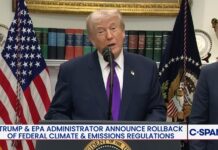
The policy shift unfolds within a wider rollback of environmental and climate measures under the Trump administration. The 2009 endangerment finding determined that greenhouse gases threaten public health and welfare and should therefore be controlled by the EPA. According to one account, by revoking it on Thursday, officials eliminated the legal foundation enabling the government to control planet-heating pollution. On Thursday, Trump said the endangerment finding formed “the basis for the green new scam.” When asked to address environmental concerns about the new rule, he responded, “Don’t worry about it.” He added, “This has nothing to do with public health.” He continued, “This is all a scam, a giant scam.”
The senators’ letter closes with a warning about what they see as the real world implications of the EPA’s revised framework. “That EPA may no longer monetize health benefits when setting new clean air standards does not mean that those health benefits don’t exist,” they wrote. “It just means that [EPA] will ignore them and reject safer standards, in favor of protecting corporate interests.”






COMMENTS