

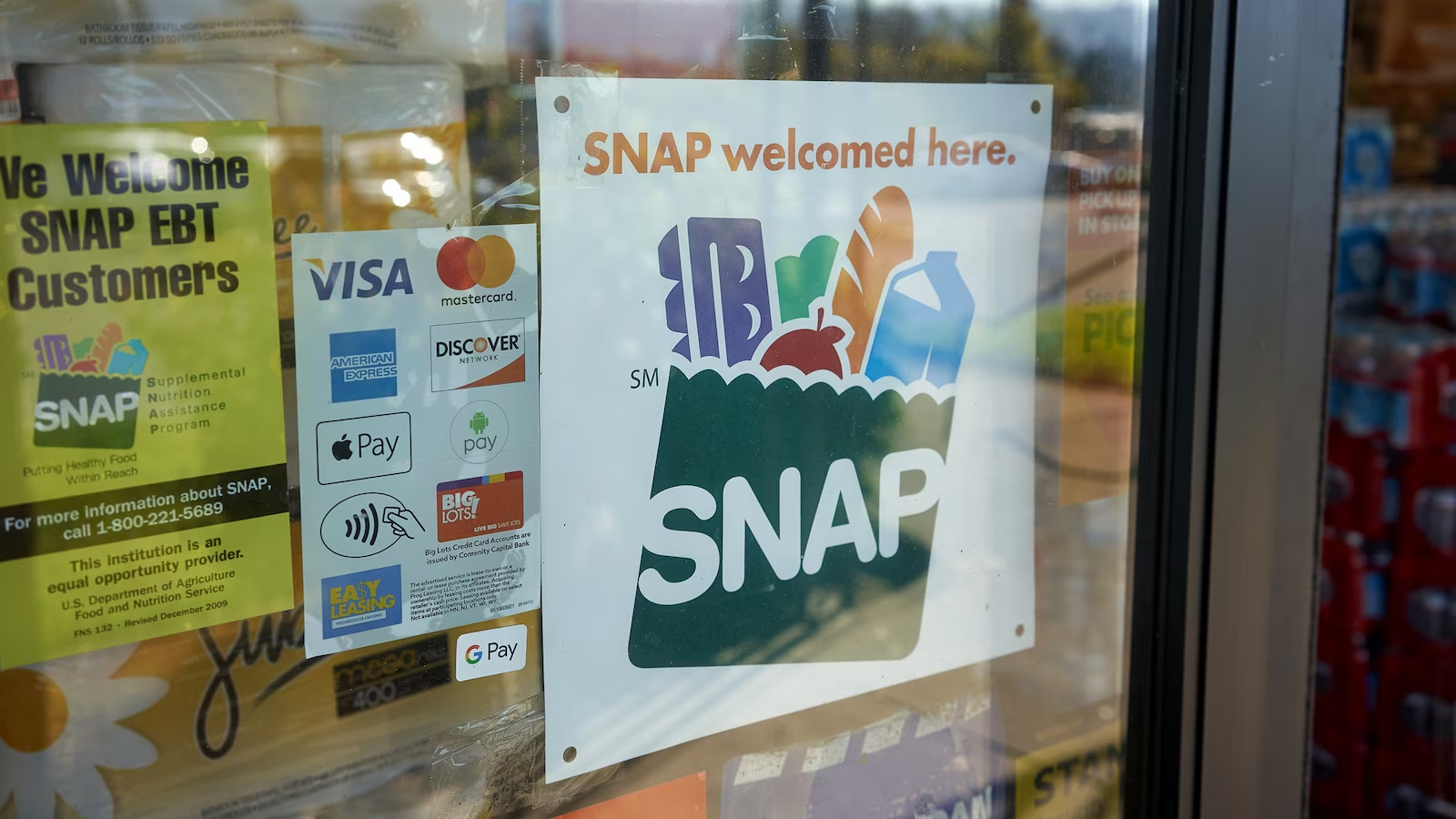
As millions of Americans face the prospect of losing critical food assistance, President Donald Trump’s administration has drawn condemnation for pledging $40 billion in financial support to Argentina while refusing to release emergency funds for the Supplemental Nutrition Assistance Program (SNAP) during the ongoing government shutdown.
Senator Bernie Sanders (I-Vt.) was among the first to condemn the move, drawing a stark contrast between the administration’s foreign spending and its domestic neglect. “During the shutdown, Trump could find $40 billion to bail out Argentina and $300 million for a ballroom to host dinner parties with billionaires, but he won’t tap emergency funds to prevent millions of American kids from going hungry? How cruel is that?” Sanders wrote on social media.
The Trump administration’s decision comes as roughly 42 million Americans face the loss of food aid in November if the government does not act. SNAP—funded at about $8 billion per month—helps low-income families buy groceries. According to the U.S. Department of Agriculture (USDA), the agency’s contingency fund currently holds approximately $5 billion, a shortfall that could have been addressed through partial payments or transfers had preparations begun weeks earlier.
Instead, officials announced that the administration would not use contingency reserves to issue SNAP benefits next month, citing legal constraints—a claim experts and lawmakers have challenged. Sharon Parrott, president of the Center on Budget and Policy Priorities and a former Office of Management and Budget official, said the administration’s refusal defies both law and congressional intent. “The administration itself admits these reserves are available for use,” said Parrott. “It could have, and should have, taken steps weeks ago to be ready to use these funds. Instead, it may choose not to use them in an effort to gain political advantage.”
At the same time, Trump’s Treasury and foreign policy officials are finalizing a $40 billion bailout for Argentina, a mix of private-sector financing and a $20 billion currency swap. The package comes as far-right Argentine President Javier Milei—an outspoken ally of Trump—secured a major midterm victory, winning roughly 40% of the national vote compared to about 32% for the opposition. The win consolidates Milei’s legislative power and allows him to continue what he calls economic “shock therapy,” a program critics say includes sweeping attacks on pensions and public health.

Trump made clear that U.S. financial support was linked to Milei’s success. “If he loses, we are not going to be generous with Argentina,” Trump said ahead of the vote. “If he wins, we’re staying with him. If he doesn’t, we’re gone.”
Rohit Chopra, former director of the Consumer Financial Protection Bureau, accused the administration of using the bailout to influence Argentina’s election. “The Trump administration’s bailout package for Argentina was explicitly designed to influence the outcome of today’s election,” Chopra said. “Congress should take a vote and block further bailout funds from flowing to Argentina. The Trump administration should focus on reducing the cost of living for Americans, rather than pouring billions into Argentina.”
Meanwhile, Democratic lawmakers have pressed the administration to release the funds already approved for food aid. Representatives Angie Craig (D-Minn.) and Rosa DeLauro (D-Conn.) said in a joint statement that “this is perhaps the most cruel and unlawful offense the Trump administration has perpetrated yet—freezing funding already enacted into law to feed hungry Americans while he shovels tens of billions of dollars out the door to Argentina and into his ballroom.”
“The president, his agriculture secretary, and his budget director need to stop playing politics with Americans struggling to afford food and release the SNAP funds that Democrats and Republicans in the House and Senate overwhelmingly voted to provide,” they added.
Democratic members of the House Agriculture Committee echoed that sentiment, accusing the administration of illegally reversing course. “They have the funding and the legal authority to provide full benefits,” the committee’s members wrote. “They chose not to use it. They’re choosing to cut food assistance for 42 million Americans.”
According to USDA officials, contingency funds are “not legally available to cover regular benefits,” asserting that such funds are intended for emergency programs like Disaster SNAP, which provides assistance after natural disasters. The department cited Hurricane Melissa as an example of why those reserves must be preserved. Critics counter that this interpretation conflicts with congressional intent and with USDA’s own shutdown plan, which acknowledges the use of multiyear contingency funds to maintain operations when appropriations lapse.
Sharon Parrott and other policy experts argue that contingency funding was specifically designed for situations like the current shutdown. The Center for American Progress stated that “the Trump administration has spent the entire year endangering the food security of millions of Americans. From terminating funding used to purchase food for schools and food banks to passing the largest cuts in SNAP history, the administration has made it clear that its goal is to take food away from hungry families—and that sentiment is extending to the USDA’s approach to the shutdown.”
Despite repeated warnings, the administration has not initiated preparations to issue even partial November payments. Politico reported that distributing partial benefits “would take weeks to dole out the money on a pro rata basis—meaning most low-income Americans would miss their November food benefits anyway.”
When asked by CNN if he would intervene to ensure funding, Trump replied only, “Yeah, everybody is going to be in good shape, yep,” offering no specifics.
The administration’s inaction has alarmed governors and state agencies responsible for processing SNAP benefits, many of which require weeks of advance notice to issue payments. For food banks and community organizations already strained by rising demand, the looming cutoff could prove catastrophic.
As the shutdown drags on, the administration’s financial priorities have become a focal point for critics. The $40 billion promised to Argentina—an IMF debtor nation whose far-right leadership Trump has openly championed—stands in sharp contrast to the $8 billion monthly cost of feeding vulnerable Americans at home.
“Congress established an emergency fund to ensure that millions of Americans on SNAP continue to receive nutrition assistance when funding expires,” Sanders wrote. “Don’t let kids go hungry. Use these emergency funds to feed low-income families.”
Get NationofChange in your inbox
Independent reporting every weekday. No paywall, no advertisers, no corporate owner. Free, and you can unsubscribe whenever you like.
Subscribe free





COMMENTS