

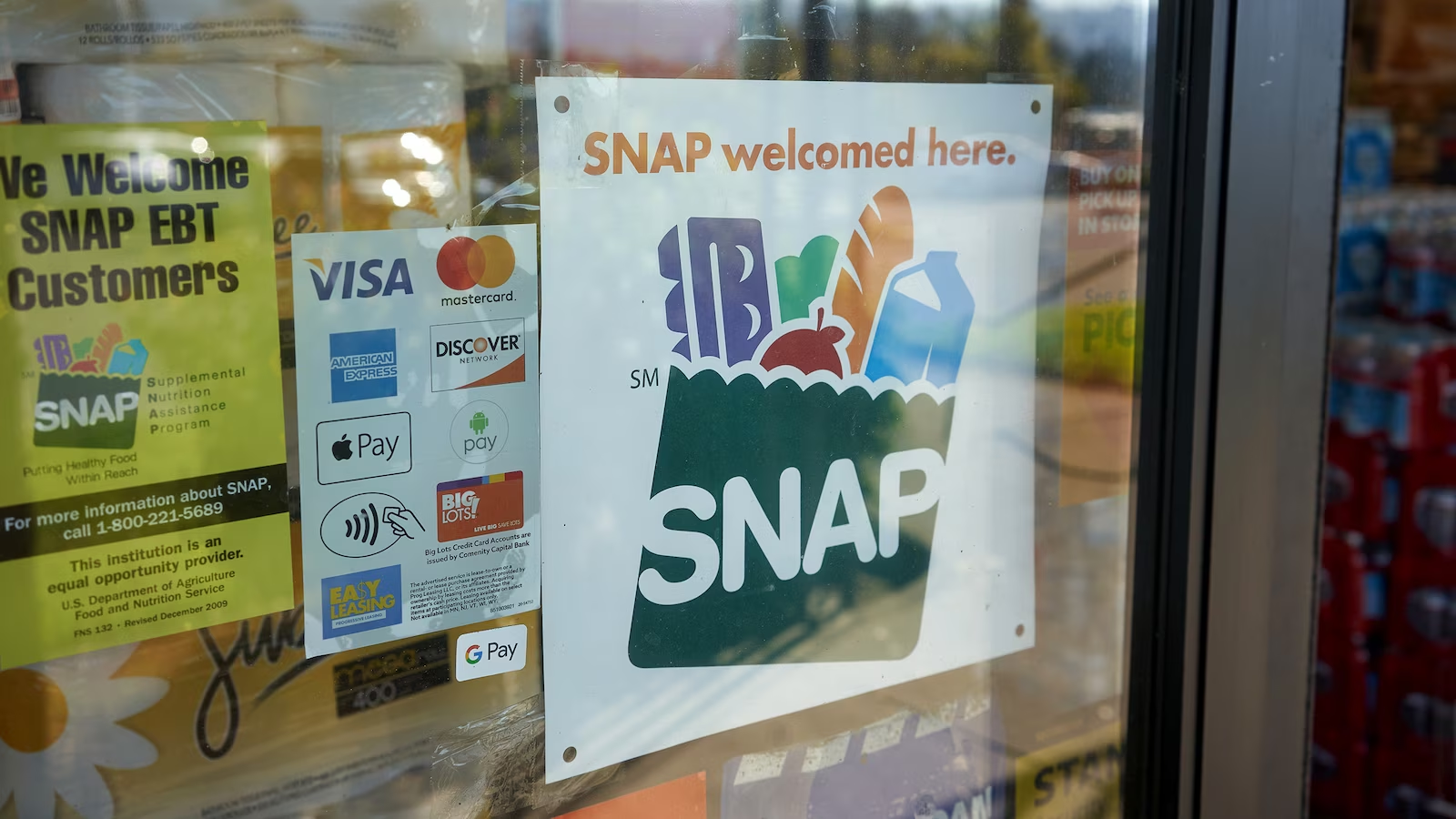
As the federal government shutdown stretches into November, states across the country are taking emergency action to keep food on the tables of millions of low-income Americans. The Trump administration’s refusal to release existing federal funds for the Supplemental Nutrition Assistance Program (SNAP) has left 42 million people at risk of missing their November benefits, collectively worth $8 billion.
The shutdown began after President Donald Trump and congressional Republicans refused to support a spending bill that would restore funding for Medicaid and extend Affordable Care Act subsidies. Democrats pushed legislation to reverse recent GOP healthcare cuts, but the administration has instead held firm, keeping the government closed and halting SNAP benefits until its demands are met.
Democratic New York Gov. Kathy Hochul has declared a state of emergency in response and committed $65 million in new state funds for food assistance, bringing the total she has announced to $106 million. “The Trump administration is cutting food assistance off for 3 million New Yorkers, leaving our state to face an unprecedented public health crisis and hurting our grocers, bodegas, and farmers along the way,” Hochul said in a statement. “Unlike Washington Republicans, I won’t sit idly by as families struggle to put food on the table.”
Hochul’s action has won praise but also renewed calls for stronger measures. Citizen Action of NY, Hunger Free America, and VOCAL-NY said in a joint statement that “we agree that the federal government is illegally, immorally, and senselessly denying food assistance to 42 million people,” but “the facts don’t support Gov. Hochul’s claim that no state can fund SNAP benefits to their residents.” The groups urged her to take the next step: “We urge her to use state funds to pay for all or some of November SNAP benefits, just as multiple other states have already done.”
Advocates pointed to states that have already filled the gap themselves. Republican Virginia Gov. Glenn Youngkin and Democratic Delaware Gov. Matt Meyer have both “committed to funding SNAP benefits for the entire month of November,” while Democratic New Mexico Gov. Michelle Lujan Grisham made a similar commitment for the first ten days of the month before reassessing the situation.

In addition to direct state funding, more than a dozen governors are releasing emergency funds to support food banks and pantries. California is releasing $80 million to bolster food banks. Connecticut is allocating $3 million, and Minnesota $4 million. Illinois announced that it is setting aside $20 million, split evenly between a new emergency reserve fund and the state’s Department of Human Services, for seven food banks.
In Hawaii, Democratic Gov. Josh Green is diverting $100 million from the federal Temporary Assistance for Needy Families program “to help families with children pay their housing and utility bills, freeing up money in the family budget to be spent on food instead.” Arizona Mirror reported that Democratic Gov. Katie Hobbs “announced Wednesday that she would disburse $1.5 million in leftover American Rescue Plan Act Covid relief funds to Arizona food banks, and that she would put another $300,000 toward an emergency fresh food program called Food Bucks Now.”
Other states are taking similar actions. Vermont’s Republican Gov. Phil Scott and the Democratic-controlled legislature announced $6.3 million to fully fund SNAP for two weeks and $250,000 for the Vermont Foodbank. North Dakota, led by Republicans, is redirecting $1.5 million in state funds, with $915,000 going to the Great Plains Food Bank and $600,000 to the Women, Infants and Children nutrition program.
Republican Missouri Gov. Mike Kehoe authorized shifting $10.6 million from a senior services fund to nonprofits providing meals for seniors and an additional $5 million in federal welfare funds for food banks. In Rhode Island, Democratic Gov. Daniel McKee declared a state of emergency to move $6 million from the Temporary Assistance for Needy Families program to households with children eligible for food stamps and allocated $200,000 to the Rhode Island Community Food Bank.
Nevada Gov. Joe Lombardo, a Republican, authorized $38.8 million to food banks but has declined to declare a fiscal emergency that would unlock additional reserve funds. Maryland Gov. Wes Moore, a Democrat, said that SNAP is a federal program and his state does not have the capacity to cover its cost.
The political and legal battle has now shifted to the courts. Over two dozen Democratic-led states have filed a lawsuit against the Trump administration, arguing that the U.S. Department of Agriculture (USDA) has the authority to use contingency funds to pay November SNAP benefits. The case, now before U.S. District Judge Indira Talwani in Massachusetts, focuses on whether USDA can release those funds during the shutdown. Reuters reported that Talwani “appeared skeptical of arguments by Justice Department attorney Jason Altabet that the contingency funds could not be used to fund SNAP benefits during the shutdown.” During the hearing in Boston, Talwani told the government’s lawyer, “You have money that was appropriated that could be used during this fiscal year.”
A separate lawsuit was filed in Rhode Island federal court by a coalition of nonprofits, small businesses, local governments, and workers’ groups represented by Democracy Forward. The complaint said that the Trump administration has “needlessly plunged SNAP into crisis” and asked the court to “immediately grant temporary relief to ensure that millions of Americans can continue to receive essential SNAP benefits.”
Public pressure is growing on the administration as well. More than 50,000 people have signed a petition launched by MoveOn Civic Action and Rural Organizing demanding that USDA Secretary Brooke Rollins release the funds. “Donald Trump is holding food for families hostage to force huge cuts to healthcare,” said Rural Organizing’s Shawn Sebastian. He added that “people all over the country, particularly rural families who will be the ones disproportionately harmed by Trump’s cruel games, are speaking out for themselves and for their neighbors, by demanding USDA Secretary Rollins meet her responsibilities to the American people, follow precedent, and continue food assistance programs during the shutdown.”
Democratic lawmakers in New York are also applying pressure. Two New York Democrats on Capitol Hill, Reps. Alexandria Ocasio-Cortez and Josh Riley, wrote to Trump and Rollins in a letter signed by the state’s entire Democratic delegation, including Senate Minority Leader Chuck Schumer and House Minority Leader Hakeem Jeffries. “With less than two days before benefits are halted, we urge USDA to use SNAP’s available contingency funds to pay out November benefits, which would cover more than two-thirds of all benefits,” they wrote. “USDA can then use its transfer authority, as it did for the Special Supplemental Nutrition Program for Women, Infants, and Children (WIC), to cover the remaining gap and ensure benefits remain uninterrupted.”
As hunger relief organizations prepare for a surge in demand, several governors have deployed state troops and volunteers to assist with food distribution. In California, Gov. Gavin Newsom has authorized the National Guard and California Volunteers to help food banks, while in South Carolina, Gov. Henry McMaster has asked the State Guard to assist with logistics. Iowa Gov. Kim Reynolds has requested that the Iowa National Guard remain on standby to support local food distribution networks.
Even with these measures, experts say state interventions will only soften the blow. The nonpartisan Fiscal Policy Institute estimated that Hochul’s $106 million in New York “would only cover six days’ worth of food” if it were directly distributed to households.
As the shutdown continues, the gap between states’ responses is growing. Families in Virginia, Delaware, or Vermont will continue to receive food benefits, while those in states like Maryland and Arkansas may go without. The patchwork response, advocates say, reveals the scale of the crisis and the harm caused by the federal government’s refusal to act.
Judge Talwani’s statement captured the core of the legal dispute when she told the government’s lawyer, “You have money that was appropriated that could be used during this fiscal year.” Despite this, the administration has not released funds or indicated any plan to do so.
“The Trump administration is cutting food assistance off for 3 million New Yorkers,” Hochul said. “Unlike Washington Republicans, I won’t sit idly by as families struggle to put food on the table.”
Get NationofChange in your inbox
Independent reporting every weekday. No paywall, no advertisers, no corporate owner. Free, and you can unsubscribe whenever you like.
Subscribe free





COMMENTS